
The Teaching & Learning Center
Game-Based Learning & Gamification
Overview
This page will explore two pedagogical approaches, game-based learning (GBL) and gamification Integrating games into the learning environment can increase learner engagement and sustain motivation using concepts like goals, interaction, feedback, problem solving, competition, and narrative.
Definitions
Game-Based Learning
Game-based learning is an active learning pedagogical approach where games are used to increase student engagement. The student learns from playing the game and promotes critical thinking and problem-solving skills. Game-based learning integrated the course content and assignments into a digital or non-digital game and may include simulations that can allow students to experience the learning firsthand.
Gamification
Gamification is where game characteristics, elements, and principles are integrated into learning activities. Here, learning activities promote student engagement and motivation to learn. Components of gamification could be points systems, badges, leaderboards, discussion boards, quizzes and classroom response systems.
The Difference
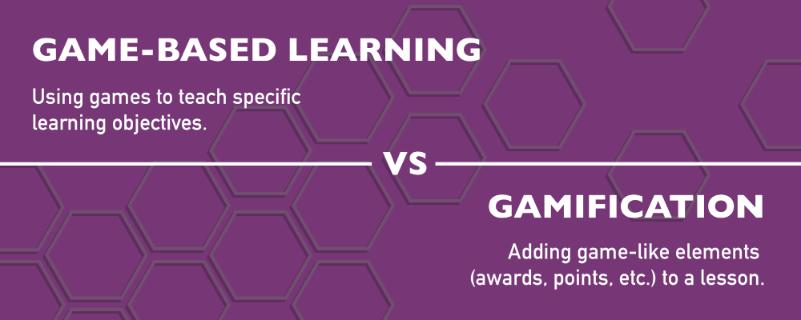
Using games to teach specific learning objectives
Adding game-like elements (badges, experience points, etc.) to a lesson.
Motivation: Games are designed to be intrinsically rewarding. May also be extrinsically rewarding.
Motivation: Likely extrinsically rewarding (the reward is tied to grades).
Assessment is in-game.
Assessment is not within the “game.”
Lesson content is adjusted to fit the game.
Game-like aspects are adjusted to fit the lesson content.
Game-Based Learning
Description
Game-based Learning (GBL) “refers to the use of video games and elements related to game reality, content, subject, and images in the educational process” (Zi-Yu et. al., 2020, p. 54). GBL starts from the beginning of the course or class period design. It turns the course or class into a game for the students.
When designing a game-based learning experience, seek to create a learning environment that is engaging, where learners will be eager to invest time in the course, learning to their fullest potential (Scholz et. al., 2021). GBL “describes an environment where the content of the game and the game itself improve[s] the acquisition of skills, competencies, and knowledge” (Zabala-Vargas et. al., 2021, p.5). GBL allows students to build intrinsic motivation, while improving their collaboration skills and content retention.
Possible Instructional Uses
- Create one class period as a game or an entire course centered around small games where students work together throughout the semester.
- Develop games for students to work collaboratively as teammates, supporting each other when an obstacle arises.
- Utilize familiar game designs to frame your GBL development, such as Jeopardy (gameshow) or Legends of Zelda (quest-based). Jeopardy can be a great review game for the end of term or unit.
- Allow students to develop “characters” for the course and rename your modules into levels, the student works through tasks at each level to make it to the next and “upgrade” their characters appearance and abilities.
- Provide feedback to students throughout the game learning in order to improve their success or point them in a new direction.
- Gauge student interest and acquire feedback in order to adjust the GBL throughout the semester/class (Di Zou, 2021).
WCU Supported Tools
- PowerPoint/Word
- H5P
- Poll Everywhere
Additional Tools
- Kahoot!
- Quizlet Live
- Quizizz
- Socrative
Tips for Using Game-Based Learning
- Game-based learning development starts early. Your student goals and objectives should be developed as a part of the design framework (Scholz et. al., 2021).
- In the beginning, ask yourself if you want your students working together or as a team. Develop the teams so that each student has an opportunity to succeed and a chance to win.
- Be mindful of students with hearing and vision impairments when designing and implementing your game-based curriculum. Research an alternative assignment that would allow them to have the same experience as their classmates.
- Allow for opportunities of choice throughout the game-instruction for students to personalize their experiences and “characters.”
Resources & Videos
- “The Effective Use of Game-Based Learning in Education | Andre Thomas | TEDxTAMU”
- Games and Templates
Gamification
Description
Gamification (or to gamify) is when you use game mechanics, aesthetics, and thinking to attract and motivate students to solve certain problems. When gamifying a course, you do not necessarily have to use electronic devices or video games for student instruction (Zi-Yu et. al., 2020).
Gamification is when you integrate game-based characteristics—such as points, leaderboards, conflict, or competition—into a preexisting learning activity or assessment to increase user/learner engagement and retention, when used appropriately (Scholz et. al., 2021; Yamani, 2021).
Possible Instructional Uses
- Utilize gamification to increase student (intrinsic and extrinsic) motivation using instructional awards for completing tasks or exemplifying course standards (Di Zou et. al., 2021).
- Create an in-classroom scoring system to build student motivation, such as providing points for participation or taking them away when class values are broken.
- Utilize small competitions to build class relationships between groups of students and encourage students to work collaboratively as teammates, supporting each other when an obstacle arises.
- Integrate badges or awards into the course curriculum. As an example, award a D2L badge when a student completes a module or a major assignment.
- Create gamified elements that allow all students a chance of success and to acquire the most points (TEDx Talks, 2016).
- Develop leaderboards or scoreboards to keep track of student point success to promote a little competition in the classroom. Make sure to allow equitable opportunities for each student to be the highest ranked.
WCU Supported Tools
- D2L Awards/Badges/Leaderboards
- Excel (Leaderboards)
Additional Tools
- Discord (Team Collaboration)
- Nearpod
Tips for Using Gamification
- Start small, begin your gamification journey with stating specific learning goals and objectives you want your students to meet (Scholz et. al., 2021).
- You do not have to do everything. With gamification you can just use one element of gaming. For example, focus on point systems for students completing tasks, participating in class, helping each other out, etc. (Kapp, 2017).
- Gauge student interest and acquire feedback in order to adjust the gamification throughout the semester/class.
- Be mindful of students with hearing and vision impairments when assigning and/or sharing gamification strategies. Research an alternative assignment that would allow them to have the same experience as their classmates.
Resources & Videos
- “Top 4 Gamification Techniques”
- “Gamification in Higher Education”
- LinkedIn Learning: Kevin Kapp’s “Gamification for Interactive Learning” Course
Game Templates & Instructional Guides
When to use a Game Template in the Classroom?
Integrating a “game show” or game template into a class-period is a type of Game-based learning. These game templates can be used for just about any content area to review content categories with a series of questions, reinforce definitions and concepts, and provide students with practice opportunities. Not only can the game be great for review, but also the game-like learning style builds motivation and enthusiasm among the students while developing collaboration skills. If you have any questions or comments please email the Teaching & Learning Center at [email protected].
Games
References
- Di Zou, Ruofei Zhang, Haoran Xie, & Fu Lee Wang. (2021). Digital game-based learning of information literacy: Effects of gameplay modes on university students’ learning performance, motivation, self-efficacy and flow experiences. Australasian Journal of Educational Technology, 37(2), 152-170. https://doi.org/10.14742/ajet.6682
- Gamify. (2020, April 19). Top 4 Gamification Techniques. https://www.youtube.com/watch?v=iX3zQo_TCM0
- Kapp, K. (2017). Gamification for Interactive Learning. Retrieved June 2, 2021, from https://www.linkedin.com/learning/gamification-for-interactive-learning/welcome
- Scholz, K. W., Komornicka, J. N., & Moore, A. (2021). Gamifying History: Designing and Implementing a Game-Based Learning Course Design Framework. Teaching & Learning Inquiry, 9(1), 99-116. https://doi.org/10.20343/teachlearninqu.9.1.9
- TEDx Talks. (2018, May 10). The Effective Use of Game-Based Learning in Education | Andre Thomas | TEDxTAMU. https://www.youtube.com/watch?v=-X1m7tf9cRQ
- TEDx Talks. (2016, April 22). Gamification in Higher Education | Christopher See | TEDxCUHK. https://www.youtube.com/watch?v=d8s3kZz1yQ4
- Yamani, H. A. (2021). A Conceptual Framework for Integrating Gamification in eLearning Systems Based on Instructional Design Model. International Journal of Emerging Technologies in Learning, 16(4), 14-33. https://doi.org/10.3991/ijet.v16i04.15693
- Zabala-Vargas, S., García-Mora, L., Arciniegas-Hernández, E., Reina-Medrano, J., Tomás, U. S., & Colombia, B. (2021). Strengthening Motivation in the Mathematical Engineering Teaching Processes—A Proposal from Gamification and Game-Based Learning. International Journal of Emerging Technologies in Learning, 16(6), 4-19. https://doi.org/10.3991/ijet.v16i06.16163
- Zi-Yu Liu, Shaikh, Z. A., & Gazizova, F. (2020). Using the Concept of Game-Based Learning in Education. International Journal of Emerging Technologies in Learning, 53-64. https://doi.org/10.3991/ijet.v15i14.14675
Link nội dung: https://melodious.edu.vn/template-tro-choi-powerpoint-a94574.html