
Best Shakespeare Sonnets
Here is a list of my favourite Shakespeare sonnets. As is often the case with these ‘best of’ lists, the audacious title is backed by little more than a one man’s love for Shakespeare. These are for me the 25 most intriguing sonnets. Poetry is a completely subjective and deeply personal thing, so you may entirely disagree, in fact I hope you do. My goal here is more to help actors or anyone interested in learning more about Shakespeare’s sonnets, be guided towards some of his most exceptional work. Shakespeare has 154 sonnets, so to pick a top 25 has not been easy, but here we are!
These sonnets investigate love, loss, deception, time, youth and are certainly not simple love poems. Like much of Shakespeare’s work, a cursory glance may lead one to believe the words are simply light, easy 14 lines of verses, but in fact they are full of pain and longing and remain some of Shakespeare’s most personal writings.
I think this list should be a good starting point if you want to learn more about Shakespeare’s sonnets. Many of these you will be familiar with (I’m sure at least the iconic Sonnet 18), and some you will not. I urge you to pick up a copy of the sonnets and read them all! If you have a personal favourite let us know in a comment below…
Top 25 Shakespeare Sonnets
-
Weary with toil, I haste me to my bed, The dear repose for limbs with travel tired; But then begins a journey in my head, To work my mind, when body’s work’s expired: For then my thoughts (from far where I abide) Intend a zealous pilgrimage to thee, And keep my drooping eyelids open wide, Looking on darkness which the blind do see: Save that my soul’s imaginary sight Presents thy shadow to my sightless view, Which, like a jewel hung in ghastly night, Makes black night beauteous and her old face new. Lo, thus, by day my limbs, by night my mind, For thee, and for myself, no quiet find.
-
Shall I compare thee to a summer’s day? Thou art more lovely and more temperate. Rough winds do shake the darling buds of May, And summer’s lease hath all too short a date. Sometime too hot the eye of heaven shines, And often is his gold complexion dimmed; And every fair from fair sometime declines, By chance or nature’s changing course untrimmed. But thy eternal summer shall not fade, Nor lose possession of that fair thou ow’st, Nor shall Death brag thou wand’rest in his shade, When in eternal lines to time thou grow’st. So long as men can breathe or eyes can see, So long lives this, and this gives life to thee.
-
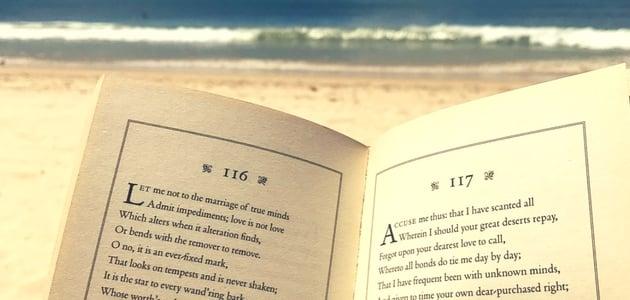
Let me not to the marriage of true minds Admit impediments; love is not love Which alters when it alteration finds, Or bends with the remover to remove. O no, it is an ever-fixed mark That looks on tempests and is never shaken; It is the star to every wandering bark, Whose worth’s unknown, although his height be taken. Love’s not Time’s fool, though rosy lips and cheeks Within his bending sickle’s compass come; Love alters not with his brief hours and weeks, But bears it out even to the edge of doom. If this be error and upon me proved, I never writ, nor no man ever loved.
-
To me, fair friend, you never can be old, For as you were when first your eye I eyed, Such seems your beauty still. Three winters cold Have from the forests shook three summers’ pride, Three beauteous springs to yellow autumn turned In process of the seasons have I seen, Three April perfumes in three hot Junes burned, Since first I saw you fresh, which yet are green. Ah, yet doth beauty, like a dial hand, Steal from his figure and no pace perceived; So your sweet hue, which methinks still doth stand, Hath motion and mine eye may be deceived; For fear of which, hear this, thou age unbred: Ere you were born was beauty’s summer dead.
-
My mistress’ eyes are nothing like the sun; Coral is far more red than her lips’ red; If snow be white, why then her breasts are dun; If hairs be wires, black wires grow on her head. I have seen roses damasked, red and white, But no such roses see I in her cheeks, And in some perfumes is there more delight Than in the breath that from my mistress reeks. I love to hear her speak, yet well I know That music hath a far more pleasing sound. I grant I never saw a goddess go; My mistress, when she walks, treads on the ground. And yet, by heaven, I think my love as rare As any she belied with false compare.
-
The expense of spirit in a waste of shame Is lust in action, and, till action, lust Is perjured, murderous, bloody, full of blame, Savage, extreme, rude, cruel, not to trust, Enjoyed no sooner but despised straight, Past reason hunted, and no sooner had Past reason hated as a swallowed bait On purpose laid to make the taker mad; Mad in pursuit and in possession so, Had, having, and in quest to have, extreme, A bliss in proof, and proved, a very woe, Before, a joy proposed; behind, a dream. All this the world well knows, yet none knows well To shun the heaven that leads men to this hell.
-
From fairest creatures we desire increase, That thereby beauty’s rose might never die, But as the riper should by time decease, His tender heir might bear his memory; But thou, contracted to thine own bright eyes, Feed’st thy light’s flame with self-substantial fuel, Making a famine where abundance lies, Thyself thy foe, to thy sweet self too cruel. Thou that art now the world’s fresh ornament And only herald to the gaudy spring Within thine own bud buriest thy content, And, tender churl, mak’st waste in niggarding. Pity the world, or else this glutton be, To eat the world’s due, by the grave and thee.
-
Since brass, nor stone, nor earth, nor boundless sea, But sad mortality o’ersways their power, How with this rage shall beauty hold a plea, Whose action is no stronger than a flower? O, how shall summer’s honey breath hold out Against the wrackful siege of battering days, When rocks impregnable are not so stout, Nor gates of steel so strong, but Time decays? O fearful meditation! Where, alack, Shall Time’s best jewel from Time’s chest lie hid? Or what strong hand can hold his swift foot back? Or who his spoil of beauty can forbid? O, none, unless this miracle have might, That in black ink my love may still shine bright.
-
So are you to my thoughts as food to life, Or as sweet seasoned showers are to the ground; And for the peace of you I hold such strife As ‘twixt a miser and his wealth is found; Now proud as an enjoyer, and anon Doubting the filching age will steal his treasure; Now counting best to be with you alone, Then better’d that the world may see my pleasure; Sometime all full with feasting on your sight, And by and by clean starved for a look; Possessing or pursuing no delight Save what is had or must from you be took. Thus do I pine and surfeit day by day, Or gluttoning on all, or all away.
-
As an unperfect actor on the stage Who with his fear is put besides his part, Or some fierce thing replete with too much rage, Whose strength’s abundance weakens his own heart; So I, for fear of trust, forget to say The perfect ceremony of love’s rite, And in mine own love’s strength seem to decay, O’ercharged with burden of mine own love’s might. O, let my books be then the eloquence And dumb presagers of my speaking breast, Who plead for love and look for recompense More than that tongue that more hath more expressed. O, learn to read what silent love hath writ; To hear with eyes belongs to love’s fine wit.
-
O, how I faint when I of you do write, Knowing a better spirit doth use your name, And in the praise thereof spends all his might To make me tongue-tied speaking of your fame. But since your worth, wide as the ocean is, The humble as the proudest sail doth bear, My saucy bark inferior far to his On your broad main doth wilfully appear. Your shallowest help will hold me up afloat Whilst he upon your soundless deep doth ride; Or being wrecked, I am a worthless boat, He of tall building and of goodly pride. Then if he thrive and I be cast away, The worst was this: my love was my decay.
-
My glass shall not persuade me I am old So long as youth and thou are of one date; But when in thee time’s furrows I behold, Then look I death my days should expiate. For all that beauty that doth cover thee Is but the seemly raiment of my heart, Which in thy breast doth live, as thine in me. How can I then be elder than thou art? O therefore, love, be of thyself so wary As I, not for myself, but for thee will, Bearing thy heart, which I will keep so chary As tender nurse her babe from faring ill. Presume not on thy heart when mine is slain; Thou gav’st me thine not to give back again.
-
Look in thy glass and tell the face thou viewest, Now is the time that face should form another, Whose fresh repair if now thou not renewest, Thou dost beguile the world, unbless some mother. For where is she so fair whose uneared womb Disdains the tillage of thy husbandry? Or who is he so fond will be the tomb Of his self-love, to stop posterity? Thou art thy mother’s glass, and she in thee Calls back the lovely April of her prime; So thou through windows of thine age shalt see, Despite of wrinkles, this thy golden time. But if thou live rememb’red not to be, Die single, and thine image dies with thee.
-
When to the sessions of sweet silent thought I summon up remembrance of things past, I sigh the lack of many a thing I sought, And with old woes new wail my dear time’s waste. Then can I drown an eye unused to flow, For precious friends hid in death’s dateless night, And weep afresh love’s long since cancelled woe, And moan th’ expense of many a vanished sight. Then can I grieve at grievances foregone, And heavily from woe to woe tell o’er The sad account of fore-bemoanèd moan, Which I new pay as if not paid before. But if the while I think on thee, dear friend, All losses are restored, and sorrows end.
-
When in the chronicle of wasted time I see descriptions of the fairest wights, And beauty making beautiful old rhyme In praise of ladies dead, and lovely knights, Then, in the blazon of sweet beauty’s best, Of hand, of foot, of lip, of eye, of brow, I see their antique pen would have express’d Even such a beauty as you master now. So all their praises are but prophecies Of this our time, all you prefiguring; And, for they look’d but with divining eyes, They had not skill enough your worth to sing: For we, which now behold these present days, Had eyes to wonder, but lack tongues to praise.
-
Devouring Time, blunt thou the lion’s paws, And make the earth devour her own sweet brood; Pluck the keen teeth from the fierce tiger’s jaws, And burn the long-liv’d Phoenix in her blood; Make glad and sorry seasons as thou fleets, And do whate’er thou wilt, swift-footed Time, To the wide world and all her fading sweets; But I forbid thee one more heinous crime: O, carve not with the hours my love’s fair brow, Nor draw no lines there with thine antique pen! Him in thy course untainted do allow For beauty’s pattern to succeeding men. Yet do thy worst, old Time! Despite thy wrong My love shall in my verse ever live young.
-
What is your substance, whereof are you made, That millions of strange shadows on you tend? Since every one hath, every one, one shade, And you but one, can every shadow lend. Describe Adonis, and the counterfeit Is poorly imitated after you; On Helen’s cheek all art of beauty set, And you in Grecian tires are painted new: Speak of the spring, and foison of the year, The one doth shadow of your beauty show, The other as your bounty doth appear; And you in every blessed shape we know. In all external grace you have some part, But you like none, none you, for constant heart.
-
Not marble nor the gilded monuments Of princes shall outlive this powerful rhyme; But you shall shine more bright in these contents Than unswept stone, besmear’d with sluttish time. When wasteful war shall statues overturn, And broils root out the work of masonry, Nor Mars his sword nor war’s quick fire shall burn The living record of your memory. ‘Gainst death and all-oblivious enmity Shall you pace forth; your praise shall still find room, Even in the eyes of all posterity That wear this world out to the ending doom. So, till the judgment that yourself arise, You live in this, and dwell in lovers’ eyes.
-
That time of year thou mayst in me behold When yellow leaves, or none, or few, do hang Upon those boughs which shake against the cold, Bare ruin’d choirs, where late the sweet birds sang. In me thou see’st the twilight of such day As after sunset fadeth in the west, Which by and by black night doth take away, Death’s second self, that seals up all in rest. In me thou see’st the glowing of such fire That on the ashes of his youth doth lie, As the death-bed whereon it must expire, Consum’d with that which it was nourish’d by. This thou perceiv’st, which makes thy love more strong, To love that well which thou must leave ere long.
-
Was it the proud full sail of his great verse, Bound for the prize of all too precious you, That did my ripe thoughts in my brain inhearse, Making their tomb the womb wherein they grew? Was it his spirit, by spirits taught to write Above a mortal pitch, that struck me dead? No, neither he, nor his compeers by night Giving him aid, my verse astonished. He, nor that affable familiar ghost Which nightly gulls him with intelligence, As victors of my silence cannot boast; I was not sick of any fear from thence: But when your countenance filled up his line, Then lacked I matter; that enfeebled mine.
-
Not mine own fears, nor the prophetic soul Of the wide world dreaming on things to come, Can yet the lease of my true love control, Supposed as forfeit to a cónfined doom. The mortal moon hath her eclipse endured And the sad augurs mock their own preságe; Incertainties now crown themselves assured, And peace proclaims olives of endless age. Now with the drops of this most balmy time My love looks fresh, and death to me subscribes, Since spite of him I’ll live in this poor rhyme, While he insults o’er dull and speechless tribes. And thou in this shalt find thy monument, When tyrants’ crests and tombs of brass are spent.
-
’Tis better to be vile than vile esteemed When not to be receives reproach of being, And the just pleasure lost, which is so deemed Not by our feeling but by others’ seeing. For why should others’ false adulterate eyes Give salutation to my sportive blood? Or on my frailties why are frailer spies, Which in their wills count bad that I think good? No, I am that I am; and they that level At my abuses reckon up their own: I may be straight though they themselves be bevel; By their rank thoughts my deeds must not be shown, Unless this general evil they maintain: All men are bad and in their badness reign..
-
Two loves I have of comfort and despair, Which like two spirits do suggest me still: The better angel is a man right fair, The worser spirit a woman colour’d ill. To win me soon to hell, my female evil Tempteth my better angel from my side, And would corrupt my saint to be a devil, Wooing his purity with her foul pride. And whether that my angel be turn’d fiend Suspect I may, but not directly tell; But being both from me, both to each friend, I guess one angel in another’s hell: Yet this shall I ne’er know, but live in doubt, Till my bad angel fire my good one out.
-
When my love swears that she is made of truth, I do believe her, though I know she lies, That she might think me some untutored youth, Unlearnèd in the world’s false subtleties. Thus vainly thinking that she thinks me young, Although she knows my days are past the best, Simply I credit her false-speaking tongue: On both sides thus is simple truth suppressed. But wherefore says she not she is unjust? And wherefore say not I that I am old? Oh, love’s best habit is in seeming trust, And age in love loves not to have years told. Therefore I lie with her and she with me, And in our faults by lies we flattered be.
-
Full many a glorious morning have I seen Flatter the mountain tops with sovereign eye, Kissing with golden face the meadows green, Gilding pale streams with heavenly alchemy; Anon permit the basest clouds to ride With ugly rack on his celestial face, And from the forlorn world his visage hide, Stealing unseen to west with this disgrace: Even so my sun one early morn did shine, With all triumphant splendour on my brow; But out, alack, he was but one hour mine, The region cloud hath mask’d him from me now. Yet him for this my love no whit disdaineth; Suns of the world may stain when heaven’s sun staineth.
Understanding a Shakespeare Sonnet
Understanding these sonnets can be tough. The archaic language and the lack of context make them a real challenge for actors and poetry lovers. I actually find unpacking a Shakespearean sonnet can be more difficult than a Shakespeare monologue in many cases. However, if we want to truly understand these wonderful sonnets, we must investigate them thoroughly. Here is my process for unlocking the sense and beauty of these sonnets:
#1 Look up unfamiliar words. Get a dictionary, ideally Shakespeare’s Words, and make sure you understand all the words in your sonnet. Another incredible tool is Etymonline. This is an online etymology dictionary. I often find this gives a clearer insight into the language and can elaborate on the historical context surrounding any difficult words.
#2 One thought at a time. Make sure you understand each thought. It’s not enough to understand the themes or the overarching sentiment. You have to understand every word, every line and every thought.
#3 Research. There are a lot of resources out there for your sonnets. Look up the context of your sonnet. Who is Shakespeare talking to and why is he saying these words? Of course you have to use your own instincts, but always best to do some research first.
#4 Read more Shakespeare. Shakespeare is like another language. To truly master Shakespeare’s 450 year old words you need to be reading, watching and working on Shakespeare text as often as you can.
#5 Who are you talking to? There are competing views on the intended subject of the sonnets, but researching this can be really helpful. The early sonnets are often attributed to the “fair youth”. Even thinking about who this mysterious youth might have been or why Shakespeare was writing these sonnets in the first place, can really unlock doors in your understanding. This RSC article could be a helpful starting point.
Reciting A Shakespeare Sonnet
Shakespeare was an actor, and his text is meant to be shared out loud! Below are several exercises that will help you in delivering a moving rendition of Shakespeare’s poetry. There is no ‘Shakespeare voice’ that you need to put on, rather, delivering a great recitation will be about connection to the thoughts and images that drive the sonnet forward. Watch master of Shakespeare Dame Judi Dench give a lovely reading of Sonnet 116 below. Notice how she speaks with her own connected, powerful, and authentic voice.
#1 Write it in your own words. No need to pay attention to syllables or rhyme scheme, write the sonnet in your own words. This can be one long paragraph, or a collection of shorter sentences. Write completely in your own words, in ehatever you need so that you can be sure you fully understand exactly what you’re trying to communicate through the poem!
#2 Take your sonnet on a walk. Walk through the space with your sonnet while reading it out loud. Take turns reading through the sonnet and noticing different elements. First, read the sonnet out loud and change your walking direction at each punctuation mark. Then, at the end of every line. Lastly, at the end of every thought.
#3 Follow through to the end of the line. We have a handy guide on how to get to the end of the line, and it’s not all just about breath!
#4 Investigate the imagery in the sonnet. For example, what kind of a star is it? The North Star, or a constellation? Which one? Take the time to really imagine each of the things you are speaking about.
#5 Really connect to the text. Support your recitation with proper breath. Stand in alignment, with a grounded connection to the earth. Avoid pacing or irrelevant movement and fidgeting while you speak. This will ensure your energy isn’t wasted on anything besides communicating the beautiful ideas and language.
Enjoy investigating these wonderful sonnets!
Link nội dung: https://melodious.edu.vn/sonnet-shakespeare-a112240.html