


I have always felt that the high of a busy Saturday in the salon is unmatched, but the physical reality of the job eventually catches up with all of us. I know that feeling when your feet are throbbing after ten hours on the floor and you realize that standing behind a chair for another twenty years might not be what you want.
I think this is a natural turning point for many of us. You have spent years perfecting your craft, and now you want a path that offers a bit more stability and professional growth. Moving into education is a great way to level up. I want to look at what is a beauty instructor today and how you can transition from a service provider to a mentor who shapes the future of our industry.
Key Insights for Future Educators
- Industry Growth: The global beauty school market is projected to reach $9.61 billion by 2026, showing that beauty education remains a sizable market.
- Stable Income: A strong public benchmark for postsecondary career and technical education teachers, a category that includes cosmetology instructors, is a median salary of about $61,490, according to the U.S. Bureau of Labor Statistics.
- Higher Standards: Modern teaching is about more than just technical skills; it involves product science, client care, and pedagogy—the actual science of teaching.
- Career Longevity: Becoming a beauty educator allows you to stay in the industry you love while reducing the physical strain of full-time salon work.
Defining the Role: Beauty Instructor Meaning and Identity
The core beauty educator meaning is about much more than just showing a student how to hold a pair of shears. I see instructors as the architects of a student’s entire career. When we define beauty culture instructor roles today, we are talking about a licensed professional who has mastered their craft and decided to focus on helping others do the same.
You might hear a few different names like hair and beauty educator or cosmetology instructor, but the goal is always the same. Your job is to take complex physical movements and turn them into steps that a beginner can understand and repeat safely.
I have noticed the industry is shifting toward a more clinical approach. According to HOTT Beauty Lounge, “Clean-ical” beauty is a major trend for 2026. For instructors, that means students may need stronger education around ingredients, product claims, skin barrier basics, and client communication. For example, you may teach students about the lipid barrier of the skin and how certain products can either support or disrupt it. You are helping them navigate a market where clients are much more educated and wellness-focused.
The Human Element
Even with all the new technology out there, people still value beauty that feels authentic and human. Mintel’s 2026 predictions highlight a “Human Touch Revolution,” where emotional connection is key. I believe schools need a beauty school educator who can teach the things an algorithm cannot, like how to handle a difficult consultation or the intuition needed for a custom color correction.
The Daily Life of a Beauty School Instructor
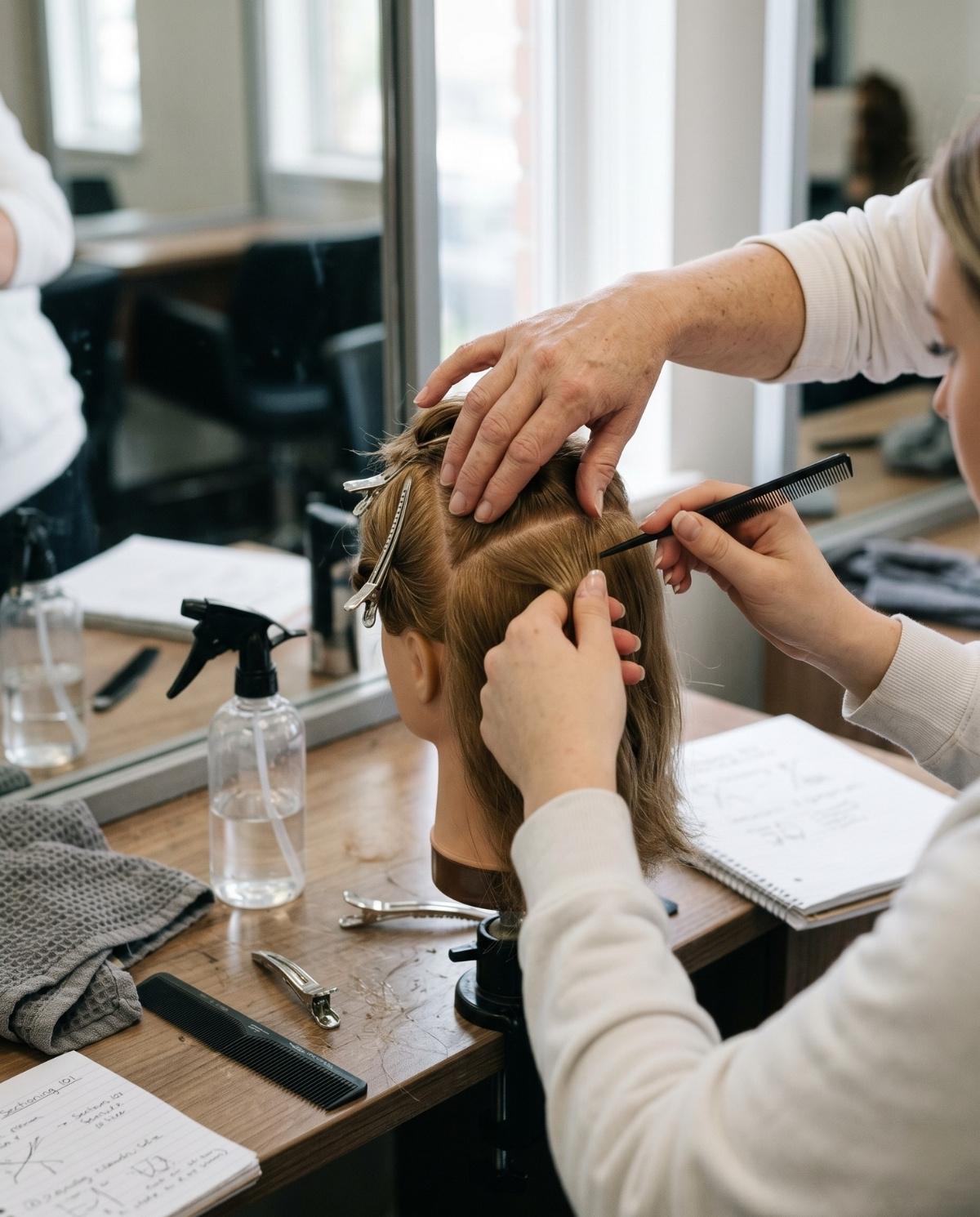
When you start your beauty instructor training, you quickly see that the job is a world away from the salon. Your beauty school instructor duties are generally split between classroom theory, coaching students, and supervising the clinic floor.
When you aren’t in the classroom teaching biology or chemistry, you are on the floor watching students work on real clients. You aren’t there to do the service for them. Instead, you guide their hands and make sure they stay within their legal scope of practice. For example, Georgia law defines services such as esthetics and hair design, and it is your job to help keep everyone safe and compliant.
A typical day in a beauty instructor school involves:
- Creating lesson plans that follow state standards.
- Giving live demonstrations of technical skills.
- Grading both written exams and practical work.
- Tracking student hours for licensing requirements.
- Maintaining a safe and sanitary environment on the floor.
- Mentoring students on soft skills like professionalism and building a business.

Understanding the Cosmetology Instructor Salary
The “feast or famine” nature of commission can be a huge stressor for many of us. I think this is why the average pay for a cosmetology instructor is such a major draw. It may offer a steadier paycheck, and school-based positions may include benefits like health insurance or retirement plans, depending on the employer.
If you are curious about how much do beauty school instructors make, it is best to look at reliable public data. O*NET lists “Cosmetology Instructor” as a sample job title under Career/Technical Education Teachers, Postsecondary. For that broader postsecondary career and technical education category, the U.S. Bureau of Labor Statistics reports a median salary of about $61,490.
Some private data from places like Franklin University suggests the median cosmetology instructor income can be higher, around $83,637, depending on the school and location. While your specific beauty teacher salary will vary, the potential for growth is real. The top earners in this broader category can make over $101,510, according to the BLS.
The broader market is also growing. Business Research Insights projects the global beauty school market to hit $9.61 billion by 2026. That does not guarantee instructor demand in every city, but it does show that beauty education remains a sizable market. Qualified beauty educators who understand both technical skills and teaching methods can be valuable to schools that want strong student outcomes.
How to Become a Beauty Instructor: The Licensing Path
If you are ready to make the switch, you have to follow a specific beauty instructor license pathway. You cannot just start teaching because you are a great stylist; you have to prove you know how to lead a classroom. I found that most states require you to hold a license in the specialty you want to teach before you can get your instructor’s license.
The general steps to become a beauty instructor usually look like this:
- Hold an Active License: You must be currently licensed in a field like cosmetology, esthetics, or nail technology.
- Relevant Experience: In Georgia, you typically need at least one year of work experience in your field before you apply to teach.
- Join a Training Program: You must enroll in a state-approved beauty instructor training program that focuses on classroom management and lesson planning.
- Complete Your Hours: According to Georgia state rules, a cosmetology instructor program requires 750 hours, while esthetics requires 500 hours and nail care requires 250 hours.
- State Board Exams: Finally, you have to pass exams that test your teaching ability and your knowledge of state laws.
The “Method of Teaching” Standard
Being an instructor is about much more than technical skill. It involves curriculum development and knowing how to evaluate students. For instance, South Carolina Bill 4752 has proposed a specific course on the method of teaching for barber instructors. I believe this shows why teaching ability matters just as much as the ability to perform a service.
Flexible Training and Online Options
I often hear people ask can I get my cosmetology instructor license online. The reality is usually a “hybrid” approach. Some schools allow you to do theory work—like learning how to create a curriculum—through an online beauty educator course. However, you almost always have to do your supervised practice teaching in person.
Choosing a beauty school educator program that offers flexibility is key for working professionals. You want a program that allows you to finish your hours without having to quit your current job entirely.

Building Your Professional Legacy at Dalton Institute
I believe that making the move into education is one of the best investments you can make in your future. You are taking all those years of hard work and turning them into a legacy by helping others succeed. Where you choose to train determines the kind of leader you will become.
At Dalton Institute, we have been part of the Georgia beauty community for over 20 years. Our team brings more than 80 years of combined experience to the table. We are a CHI partner school, and we focus on giving you the mentorship you need to step away from the chair with confidence. Our Instructor Training program is designed for experienced professionals who want to share their knowledge in cosmetology, barber, nails, and esthetics. The curriculum includes lesson planning, teaching methodologies, classroom management, curriculum creation, and instruction delivery methods, giving future educators the foundation they need to step into a teaching role with confidence.
If you are ready to find out how you can start this journey, you can see more details on our Enrollment page. I also suggest checking out the contact form we have at the bottom of this article. You can reach out to us with any questions about our upcoming schedules or the enrollment process. Your next chapter as a mentor starts here.
FAQ: What You Need to Know About Beauty Education
How long does it take to become a cosmetology instructor? Most people finish their training in 6 to 12 months. In Georgia, it takes 750 hours for cosmetology, 500 for esthetics, and 250 for nails.
What is the difference between an instructor and a beauty educator? These terms are often used interchangeably. However, an “instructor” usually works within a licensed school, while a “beauty educator” might work for a specific brand or travel to different salons.
Is there a way to become a beauty educator online for free? You might find free workshops, but getting a state license requires a formal program and passing the state board exams. Some theory might be online, but hands-on practice is a requirement.
What can I do with a beauty instructor license? Besides teaching, you could become a school director, a brand trainer, or even a curriculum developer for major beauty companies.
